May 01, 2010

Abstractification through Camera Movement

Now today is the 1st of May and we should celebrate this with some colorful flowers, shouldn't we?

Here's an image of a rose I like very much:

Rose 13426

I shot this with a 400mm lens at f/32, 1/6 sec, ISO 200. The 1/6 sec together with the large magnification of the lens allowed me to produce quite some motion-blur when I tried various camera-movements. The trick is to find the right movement that fits with the natural structure of your subject. In this case it was some sort of "drop-shift".
There is very little post-processing in this image. Just contrast enhancement plus some color-tweaking, as this technique reduces contrast and saturation.

When you look at the long exposure times you need in this kind of shot under bright sunlight you need one or more of the following:
- lens that can stop down to f/22, better f/32
- lowest camera-ISO of 200, better 100
- Neutral density filter (I did this without)
I've done most of my work of this kind hand-held with shutter speeds between 1/8 sec and 1 sec

April 28, 2010

Abstractification through B&W Conversion (2)

The following image is a prime example of how b&w conversion emphasizes the nature of light in an image. This on is called
Morning Light:
Morning Light 19498

There is also some contrast-tweaking with curves because the gradient in the contra-light is very subtle.
Taking this image in you may find it pretty realistic looking, although all colors are missing. Seems to relate quite well to the impression I had when standing there: in the strong contra-light and the slight mist colors really looked very subdued to the eye. The only exception being the green of the undergrowth.

April 27, 2010

Abstractification through B&W Conversion (1)

Funny how the limitations of film in the early days made each photograph an abstract reproduction / object of abstract art: The color-palette of the original subject was replaced by a grey-scale and the use of colored filters to influence the reproduction/mapping of different colors to various shades of grey was commonplace.
Today most photos/videos are in color and a b&w conversion is a deliberate decision to take away the colors and thus abstractify the picture.
For me there are two major reason to use b&w: To emphasize form/gestalt over color and/or to increase the impact of light-gradation and thus emphasize the nature of light in an image.
I'll show you some examples in my next post.

Btw. Today most images are two-dimensional and not many people think of that as an abstraction from reality. But with the increasing use of 3D-techniques in the cinemas I’m pretty sure that in 50 years time 2-dimensionalty / taking away the depth of an image will count as abstraction too.

April 25, 2010

Structured Glass

This shot of a cactus was done through the structured glass of a green house:
Cactus 25425
See how the structured glass makes the cactus look like under water or like aspic-preserved.
(as always, clicking on the image leads you to the flickr-page of the image where larger sizes can be accessed through the "All Sizes" button)
The effect is largely dependent on the distance of the subject from the glass. That's because the glass is such a strong modifier (at least compared to rain) that you'd reduce your subject to mush when you place it too far from the window.

April 23, 2010

Abstractification through dof / oof

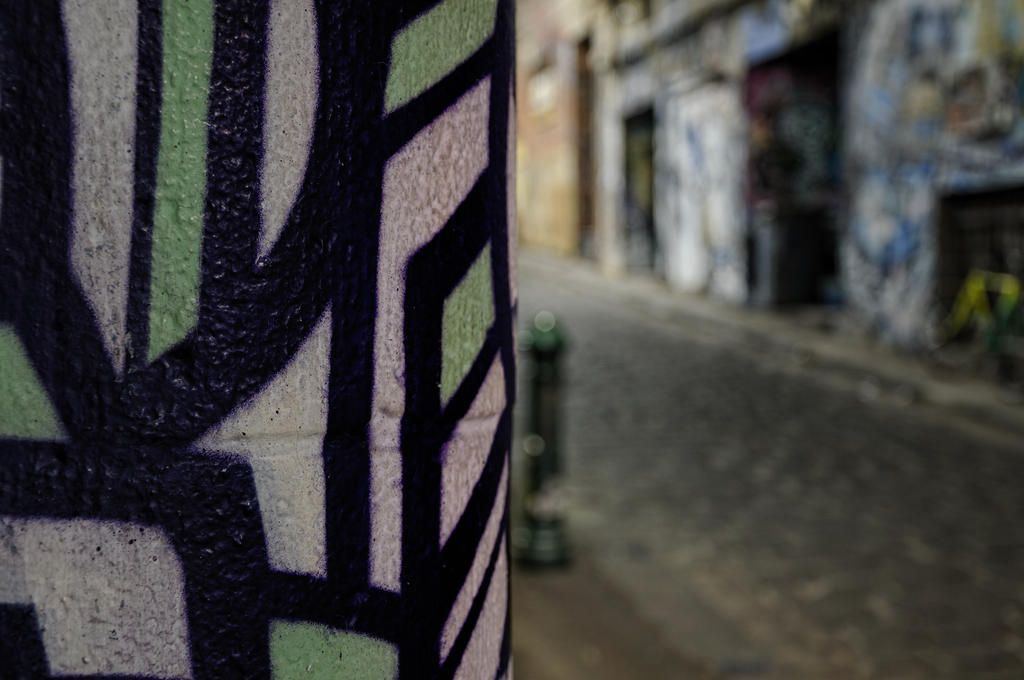
Funnily I just stumbled across an image with the title "post abstract expressionist impressionism" that shows pretty well, what dof/oof can do to abstractify your photos:
Bleed 25186
(c) arthurking83
You can follow the thread about this image here.
This shot is a nice example of mixing sharply depicted abstract graffiti and unsharp realistic scenes (the street) to produce a quite unique photo.

April 21, 2010

How to achieve Abstracticism

Let's make a little list about ways to abstractify photographs.

First up there are all the things you can do with post-processing. And I don't dare to list them all, because you can argue that in the end every tool apart form cropping/rotating is a step away from the most realistic representation of your subject. So instead I'll list the manipulations that I'd be using in my efforts to abstractify:
- B&W conversion
- Exposure compensation and curves
- Manipulating hue and saturation of colors
- Merging multiple exposures

And then there are the things you can do with your camera while taking the picture:
- Aperture: use large apertures to limit dof, reduce contrast, produce vignetting
- Focus: using mis-focus to deliberately produce oof results
- Exposure: over-/underexpose
- Shutter: use slow shutter speeds in connection with movement of subject (motion blur) and/or movement of the camera (shake, displace, rotate)
- Interaction of strong light with the lens resulting in flare/glare/ghosting, sunstars
- Lens effects: like from a fisheye, a lomo-camera*, from a lensbaby, or even from using no lens at all
There are also all kinds of capabilities of modern cameras like picture styles, multiple exposures, b&w conversions that can be done in-camera. But for the sake of simplicity I'd consider all this as post-processing as it does not influence the RAW image and normally can be far better controlled with software.

And finally there are all the options that lay outside the camera but influence the RAW image. Let's call them reality-modifiers:
- Filters and filter-like natural effects like haze/smoke/fog, rain/snow
- Reflection/refraction in "non-perfect" media like water, (curved) glass, metal, hot air
- extreme magnification or unusual/strange perspectives and framing can also yield quite some abstractification
All those reality-modifiers have in common that the effect can be seen with the naked eye (perhaps apart from extreme magnification).

I'd like to delve deeper into those abstractifiers in the upcoming posts and also post images to show the effect(s). And if you have other methods outside post-processing add those in a comment!

So, stay tuned...

---
*Here is a nice article about "How To Make Digital Photos Look Like Lomo Photography"

April 20, 2010

Any Comments?

I encourage you to comment on any of my posts or if you don't find an appropriate article please put your comment here!
I've chosen settings where anyone may place a comment here, even anonymous users. I also switched off "word verification" to make it easy for you to leave your comment. But that will only hold up when the comments stay civilized and on topic.
If you like to know what I advocate when commenting, here are the house-rules.